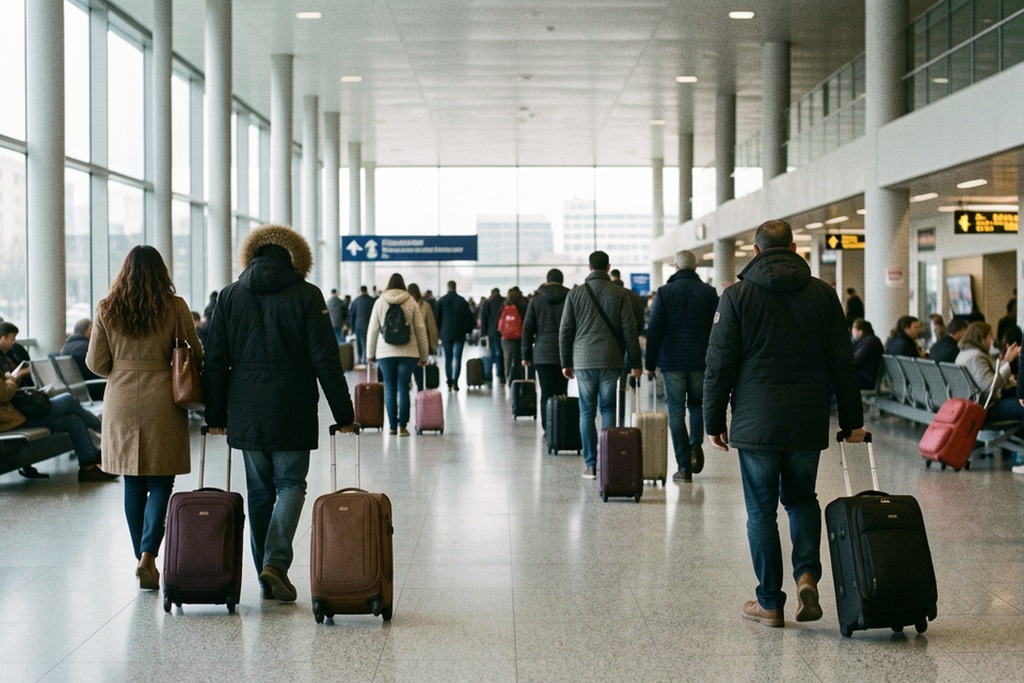
Argentines made many more trips abroad while fewer foreigners entered the country in May 2025, official data reported on June 25 showed. Outbound travel was up 45.8% from May 2024 and inbound visits down 14.2%, according to INDEC figures reported by the Buenos Aires Herald. It was a warning for a government seeking foreign currency: a relatively expensive Argentina made overseas holidays attractive to residents with spending power while eroding the value proposition for visitors.
The Herald also cited separate INDEC spending figures for the first quarter of 2025: Argentines spent $4.92 billion on travel abroad and foreign visitors spent $1.45 billion in Argentina. The resulting $3.47 billion difference was a tourism-spending balance for that quarter, not the country's entire balance of payments or a measure of all residents' welfare. Visitors, border-crossers and spending flows answer different statistical questions; the May counts should not be casually mixed with the first-quarter dollars as if they covered the same period.
What a strong peso changes
For a traveler paying in dollars or reais, what matters is the local cost after exchanging currency. When Argentine prices rise faster than the peso weakens, hotel rooms, meals and transport can become more expensive in foreign-currency terms. Economists interviewed by the Herald attributed the tourism shift partly to the government's exchange-rate policy and an appreciated peso used as an inflation anchor. That analysis is an explanation of relative prices, not proof that exchange-rate policy alone accounted for every visitor's decision. Air links, safety perceptions, attractions and seasonal choices also matter.
The numbers illustrate two sides of the same currency effect. Residents who can afford tickets and foreign hotels may find shopping and vacations abroad comparatively cheap. Incoming travelers, especially from neighboring countries, can choose competing destinations. In May the Herald reported 1.31 million Argentines traveling abroad against 572,900 foreign visitors entering Argentina. The paper named Chile, Brazil and Paraguay as leading destinations for Argentine residents. None of that implies all households enjoyed cheaper holidays; it says those already able to travel had a stronger incentive to do so.
An unequal travel boom
The distributional distinction is central. The Herald cited analysis from the Moiguer consultancy saying lower-income households struggled with basic expenses even as wealthier groups increased spending in dollars on travel and imported goods. A headline about crowded border crossings can thus coexist with weak domestic mass consumption. Tourism businesses at home face the reverse squeeze: higher local costs and customers drawn to other countries. A hotel or restaurant's response cannot be as quick as a traveler's booking choice, particularly where buildings, staff and regional flight connections require long planning horizons.
The currency consequences also complicate Milei's fiscal and anti-inflation story. A stable-looking exchange rate can help suppress the local cost of imported goods, but if it increases spending outside the country and reduces receipts from foreign visitors, it can deepen demand for dollars. Economists disagree about how much currency appreciation is policy-made and how much reflects other capital and trade flows. The published travel figures are evidence of the result for the sector, not a complete verdict on the government's monetary framework.
What comes next
Tourism operators had to watch whether relative prices changed, whether Argentine families continued booking abroad and whether inbound demand recovered after the May reading. Policymakers had to weigh the short-term benefit of an inflation anchor against the harder-currency outflow implied by a travel-spending deficit. The June release made that trade-off concrete: fewer foreign visitors were paying into Argentina's economy at the same time that more Argentine visitors were paying into others'.