Argentina admitted a YPF-led oil pipeline from Vaca Muerta to the Atlantic coast into its large-investment incentive program on March 14, 2025, giving a flagship energy project a clearer tax and regulatory route. Economy Minister Luis Caputo announced the decision, reported by Reuters, and estimated its cost at nearly $3 billion. He said that once running, the project should enable more than $15 billion a year in oil exports. Those figures were the minister's projections for a future operating pipeline, not earnings already recorded.
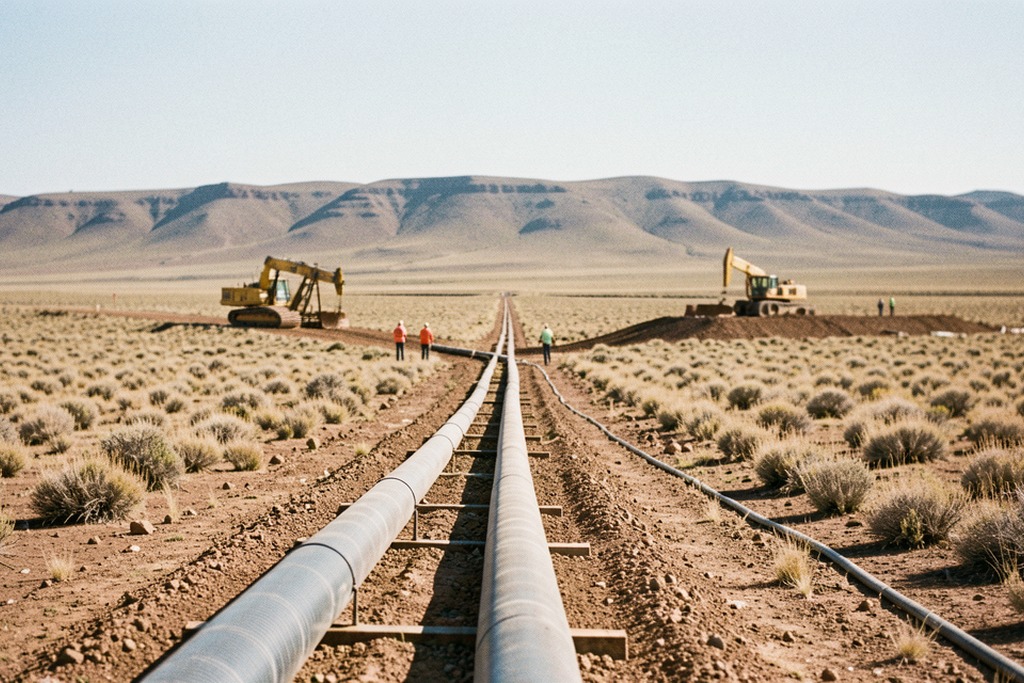
The route would take crude from Argentina's vast Vaca Muerta shale formation to a port in the Patagonian province of Río Negro. YPF is developing it with partners including Shell, Chevron, Vista and Pan American Energy. The group had sought admission to the incentive scheme the previous year. What the decision delivered was eligibility for a framework intended to make large investments easier to finance; it did not itself lay pipe, secure customers or produce an additional barrel.
Oil below ground needs a route to sea
For foreign buyers, Vaca Muerta's size has never been the whole investment case. A well's production is worth less if transport capacity constrains delivery to refineries or export terminals. The proposed link seeks to connect new shale output with ocean-going markets, reducing dependence on existing bottlenecks. Reuters described Vaca Muerta as holding the world's second-largest shale gas reserves and fourth-largest shale oil reserves. The country's hope is to make energy exports a sustained source of hard currency rather than a sequence of promising reserve estimates.
YPF's role also shows that Milei's market-oriented investment policy was not simply a retreat by the state from energy. A company controlled by Argentina was coordinating with international and domestic producers to build shared infrastructure. Private partners would have an interest in reliable access; YPF and the government had an interest in exports and the foreign currency they generate. RIGI's policy promise was a longer planning horizon for capital-intensive projects exposed to Argentine tax and exchange-rate risk. Rio Tinto's description of the framework highlights lower tax rates, faster depreciation and long-term regulatory stability.
Forecasts are not receipts
Caputo's projected annual exports should be read as an argument for the project, not as a forecast guaranteed by the approval. Volume depends on wells, construction, shipping capacity and oil prices. A company that must finance a multi-billion-dollar line today faces uncertainty about both future output and the rules under which it will recover its investment. That is why admission to the incentive regime matters before the first tanker sails. It lowers some policy risks while leaving engineering and commercial risks in place.
There is also a wider national trade-off. Incentives can accelerate infrastructure that ordinary credit conditions would make difficult, but foregone tax receipts or preferential treatment have a cost. Other industries cannot simply claim the same export potential. Provinces will expect employment and local benefits, while the national government will judge success by actual foreign-exchange earnings. None of those outcomes followed automatically from Friday's announcement.
What comes next
The next milestones were contracting, finance, construction and the export terminal's capacity to handle crude volumes from the basin. Producers would have to align drilling plans with the line's opening, and investors would have to see whether promised protections worked in practice. The March approval was nevertheless a consequential signal: the administration was betting that a physical exit to the coast, backed by legal incentives, could turn Vaca Muerta from a geological opportunity into a large-scale export business.